Loose Leaf Binder Ring & Book Ring: The Ultimate Guide for Document Organization
Loose Leaf Binder Ring & Book Ring: The Ultimate Guide for Document Organization
In the digital age where electronic documents dominate daily office and study scenarios, physical paper organization still remains an irreplaceable part of personal learning, business operation, and creative recording. Among all stationery accessories that support manual document management,loose leaf binder rings (also widely known as book rings) stand out as the most practical, flexible, and cost-effective binding solution. Unlike traditional perfect binding, stapling, or thermal binding that fix paper pages permanently, loose leaf binder rings enable free addition, deletion, rearrangement, and replacement of pages, perfectly meeting the dynamic organization needs of modern users.
Whether you are a student sorting class notes, an office worker organizing business documents, a designer arranging creative manuscripts, or a DIY enthusiast making handcrafted notebooks, book binder rings can provide a hassle-free binding experience. This comprehensive guide will dive deep into the definition, types, materials, specifications, applications, selection tips, and maintenance methods of loose leaf binder rings, helping you fully understand this essential stationery accessory and choose the most suitable product for your daily use.
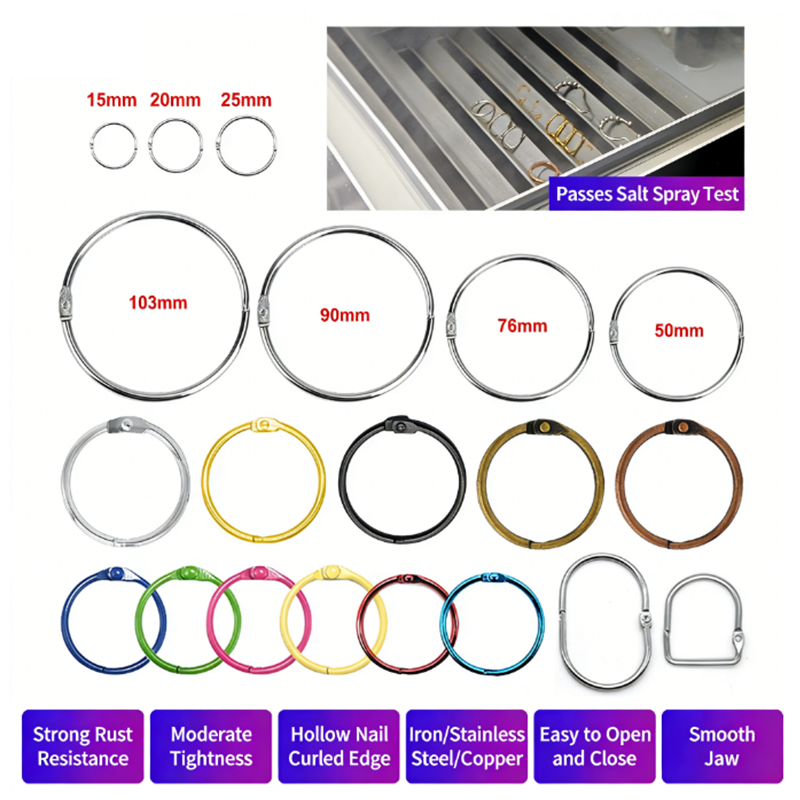
1. What Are Loose Leaf Binder Rings and Book Rings?
Loose leaf binder rings are reusable ring-shaped binding accessories designed for punched loose-leaf papers, cards, and thin sheet materials. In cross-border e-commerce and global stationery markets, the terms loose leaf binder ring and book ring are universally interchangeable, both referring to openable and closable loop binding tools that require no professional binding machines.
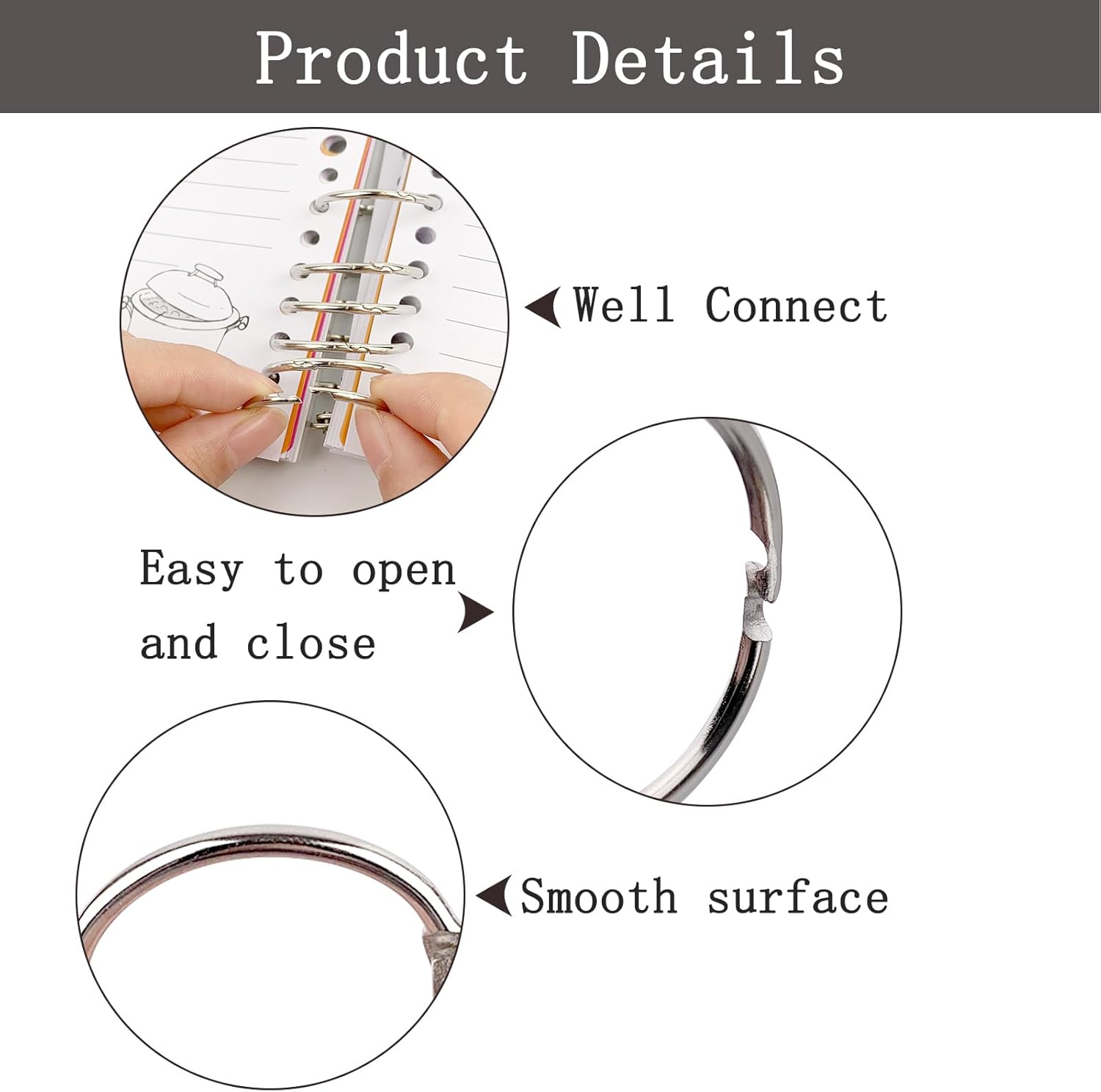
The core working principle of book rings is simple and efficient: users only need to punch standard holes on paper or materials with a hole puncher, open the ring buckle, thread the punched pages onto the ring, and lock the ring tightly to complete document binding. This tool abandons the defects of traditional binding methods such as one-time use, poor adjustability, and difficult page replacement, realizing truly flexible and permanent reusable document organization.
Different from fixed notebook coils and glued bindings, loose leaf binder rings feature detachability, adjustability, and durability. They can be reused for years without damage, greatly reducing stationery costs for individuals and enterprises. Meanwhile, their lightweight design and diverse specifications make them compatible with almost all mainstream loose-leaf paper sizes, including A4, A5, B5, and mini pocket sizes, becoming a universal binding solution for global users.
2. Core Types of Loose Leaf Binder Rings
With the continuous upgrading of stationery technology and diversified market demands, loose leaf binder rings have derived multiple classification types based on structure, opening mode, and shape. Each type has unique functional advantages and applicable scenarios, covering daily light use, heavy-duty office use, and personalized DIY creation.
2.1 Snap Open Book Rings (Single-Loop Snap Rings)
Snap open book rings are the most classic and widely used basic type of loose leaf binder rings. They adopt a single-loop split design with an elastic snap structure, which can be easily opened by pinching both sides with fingers and automatically locked after closing. This type of ring features ultra-simple operation, no auxiliary tools required, and high flexibility.
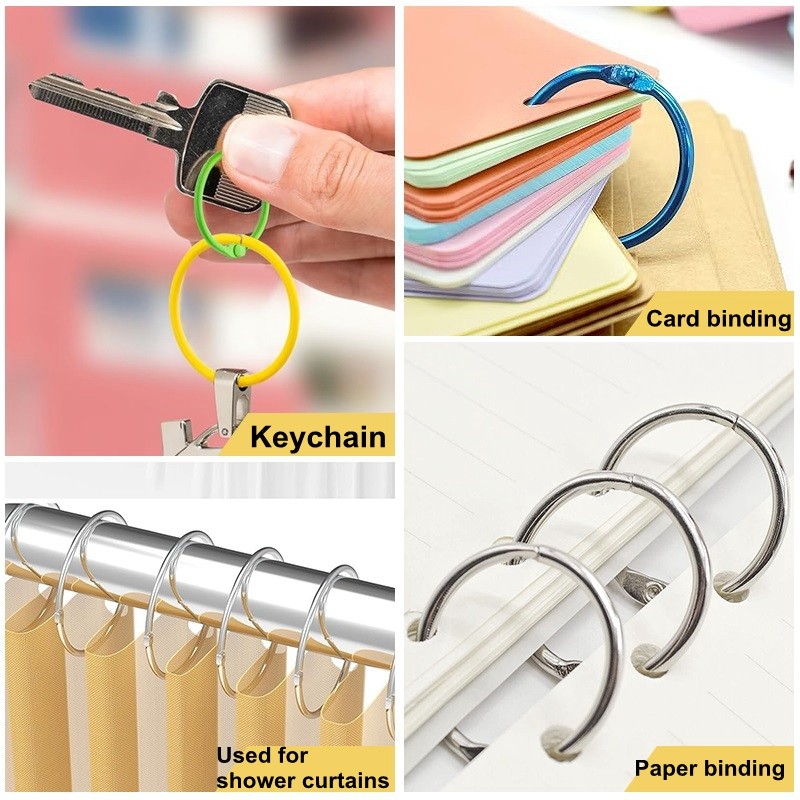
Suitable for light-duty binding scenarios with fewer pages, snap rings are perfect for binding daily notes, index cards, recipe cards, and temporary sorted documents. Their lightweight and portable characteristics make them the first choice for student daily study and family daily document sorting. However, due to the single-loop structure, their bearing capacity is limited, and they are not suitable for binding thick document stacks with excessive pages.
2.2 Double-Loop Locking Binder Rings
Double-loop locking binder rings are an upgraded version of traditional snap rings, adopting a double-row closed-loop structure with a professional locking mechanism. Compared with single-loop rings, this type of ring has stronger structural stability, not easy to deform or loose, and can firmly lock pages to prevent paper slipping and scattering during carrying and flipping.
The biggest advantage of double-loop locking rings is their heavy-duty load-bearing capacity. Thickened metal or high-strength plastic materials enable them to bind hundreds of pages of documents without deformation. The precise locking design ensures tight closure, avoiding the common problem of loose ring openings in ordinary snap rings. They are widely used for binding thick office manuals, project documents, student review materials, and long-term archived files.
2.3 O-Ring vs D-Ring Binder Rings
According to the ring shape, loose leaf binder rings are divided into O-rings and D-rings, two mainstream structural types favored by commercial binder manufacturers. O-rings present a standard circular shape with uniform force on all sides, smooth page flipping, and balanced overall bearing. They are the most universal ring type, suitable for most standard loose-leaf binders and daily binding scenarios.
D-rings adopt a flat D-shaped structure with a straight side and a curved side. The straight side fits closely with the binder base, which effectively saves space and prevents the ring from tilting and deforming when bearing heavy pages. Compared with O-rings, D-rings have larger page capacity under the same diameter specification, can bind more documents, and keep the binder flat and neat after closing. They are more suitable for high-capacity office binders and professional document storage.
3. Main Materials of Book Binder Rings & Their Advantages
The material of loose leaf binder rings directly determines their durability, load-bearing capacity, appearance texture, service life, and applicable scenarios. At present, the mainstream materials on the market are divided into metal and plastic, each with distinct performance characteristics and user positioning. Users can select targeted products according to usage frequency and scene demands.
3.1 Metal Binder Rings (Iron & Stainless Steel)
Metal binder rings are the most popular high-performance type, mainly made of high-quality iron and stainless steel, with surface treatments such as electroplating, frosting, and anti-rust coating. Metal materials have outstanding hardness, toughness, and compression resistance, not easy to bend or deform even after long-term frequent opening and closing.
Core advantages of metal book rings: First, ultra-strong durability, with a service life of more than several years, suitable for long-term repeated use and high-frequency office scenarios. Second, stable load-bearing performance, thickened metal rings can bear thick document stacks without loosening, ensuring firm page fixation. Third, high-end appearance texture, electroplated silver, black, and gold finishes present a neat and professional visual effect, in line with commercial and formal office scenarios. Fourth, anti-rust and anti-oxidation performance, qualified metal rings undergo professional surface treatment to avoid rust and discoloration in daily use.
Metal binder rings are the preferred choice for enterprise offices, institutional file archiving, professional document sorting, and high-frequency daily use. They are slightly higher in price than plastic rings, but their super durability and stable performance make them have higher cost performance in long-term use.
3.2 Plastic Binder Rings
Plastic loose leaf binder rings are made of high-quality PP, PVC, and ABS environmental protection plastics, featuring lightweight, rich colors, low price, and diverse styles. As an economical and personalized binding solution, plastic rings occupy an important position in the civilian stationery market.
Core advantages of plastic book rings: Firstly, ultra-light weight, no heavy feeling after binding documents, easy to carry and store, very suitable for student school bags and portable notebooks. Secondly, rich color options, including transparent, black, white, pink, blue, and other gradient colors, supporting personalized DIY notebook creation and color-coded document classification. Thirdly, low cost, affordable for bulk purchase, suitable for large-scale daily use and temporary binding needs. Fourthly, safe and non-scratch, the smooth plastic surface will not scratch paper or hands, with higher safety for student use.
The disadvantage of plastic rings is that their hardness is slightly lower than metal rings, and they are prone to deformation when bearing excessive pages or being squeezed by external force. They are more suitable for light-duty use scenarios such as student notes, life records, and temporary document sorting.
4. Final Conclusion
Loose leaf binder rings (book rings) are small but powerful stationery accessories that integrate practicality, economy, and environmental protection. Whether for student learning, business office, family sorting, or handmade creation, they can provide efficient and flexible document binding solutions. With diverse types, complete specifications, and reliable quality, high-quality binder rings can meet the personalized needs of different scenarios and users.
Choosing the right material, size, and structure of loose leaf binder rings can completely optimize your document management mode, bid farewell to messy paper stacking and frequent stationery replacement, and realize efficient, orderly, and sustainable paper resource management. As an essential basic stationery for long-term use, reusable book rings will always be a cost-effective and practical choice for every study, office, and life scenario.