1. What Are Loose Leaf Binder Rings and 3 Ring Binder Rings?
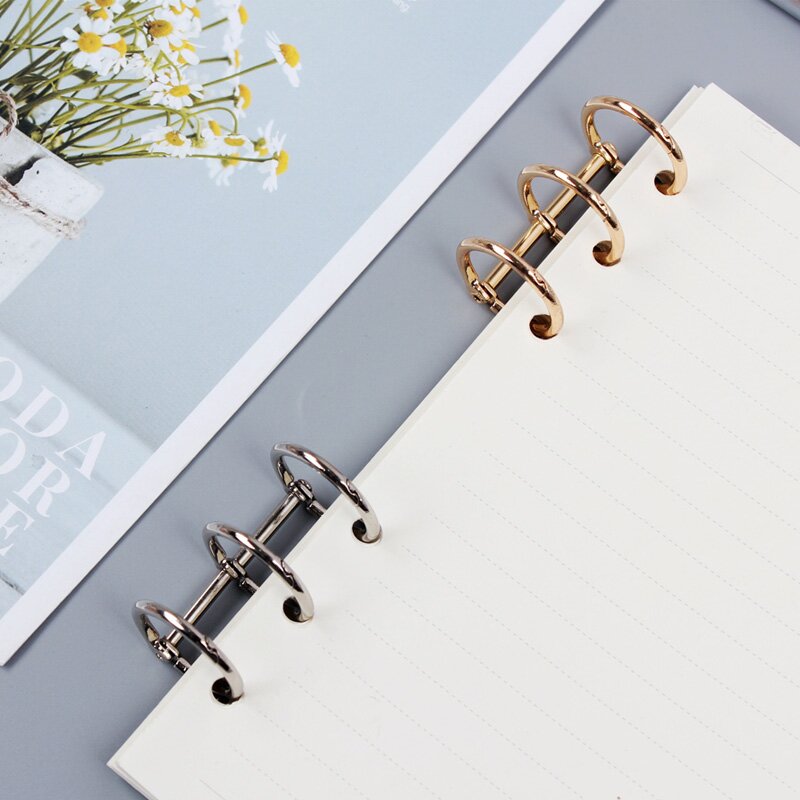
Loose leaf binder rings are detachable, openable metal ring fasteners used to bind loose-leaf paper, cards, transparencies, and other punched documents. Unlike traditional glued or stitched binding, loose leaf ring binding allows users to freely add, remove, replace, and rearrange pages without damaging documents, which is the core advantage of loose-leaf stationery systems.
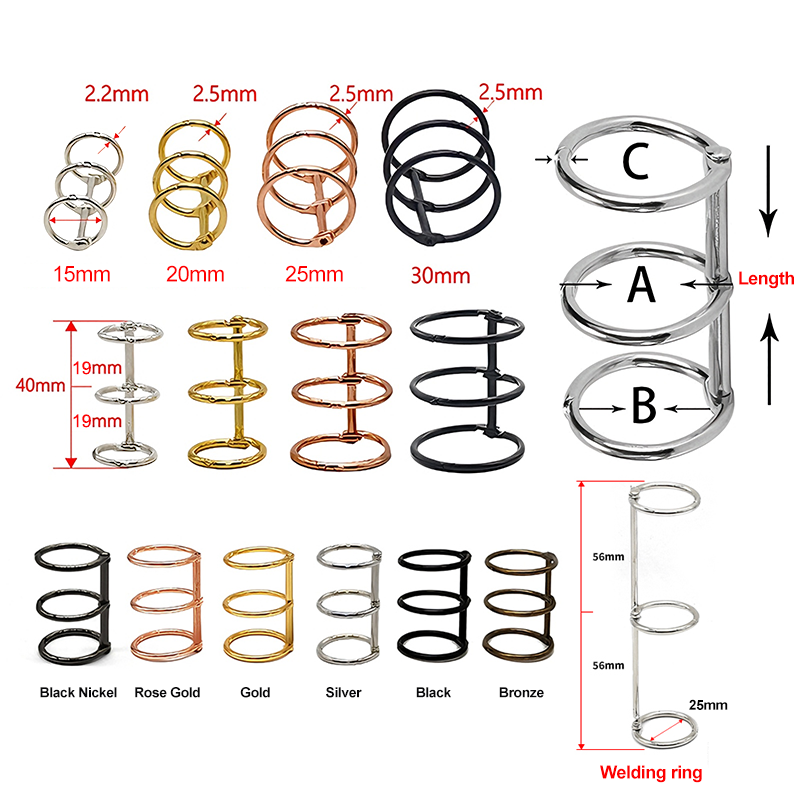
The term 3 ring binder ring specifically refers to the standard three-ring configuration, the most mainstream specification in global office and school supplies. Standard 3 ring binder rings follow universal industry spacing, matching the standard three-hole punching layout adopted by most loose-leaf paper, notebooks, and binder folders worldwide. While single-ring, two-ring, and four-ring styles exist, 3 ring binder rings dominate the market due to their perfect balance of fixing stability and operational flexibility.
2. Core Types of 3 Ring Binder Rings
Not all 3 ring binder rings are the same. Different ring shapes and structural designs directly affect paper capacity, page flipping smoothness, and service life. The two most common types on the market are O-ring and D-ring binder rings, each with unique functional advantages and applicable scenarios.
2.1 O-Ring Binder Rings (Round Ring)
O-ring loose leaf binder rings are the classic circular ring design, the most traditional and cost-effective option for daily use. Featuring a full circular structure, these rings have uniform force and simple opening and closing operation. They are lightweight, affordable, and widely compatible with all standard three-hole punched papers.
2.2 D-Ring Binder Rings (D-Shaped Ring)
D-ring binder rings adopt a semi-circular flat design, with one side straight and the other side arc-shaped. This optimized structural design solves the page bending problem of traditional O-rings and greatly improves paper storage capacity. Under the same diameter specification, D-ring 3 ring binder rings can hold 20% to 30% more paper than O-rings.
In addition, the flat side of the D-ring fits closely to the binder spine, making the whole binder flatter and neater after closing. Pages can be flipped more smoothly without jamming or curling, which is very suitable for thick documents, long-term preserved files, and frequently flipped planners. D-ring loose leaf binder rings are the preferred choice for commercial office, professional file management, and high-end custom notebooks.
3. Key Material & Craft Features of Premium Loose Leaf Binder Rings
The durability, texture, and service life of 3 ring binder rings depend entirely on material selection and production technology. High-quality loose leaf binder rings always adopt high-standard metal materials and fine surface treatment processes to ensure rust resistance, deformation resistance, and smooth operation.
3.1 Premium Metal Materials
Formal high-grade 3 ring binder rings are mostly made of high-quality carbon steel or stainless steel, with high hardness and strong toughness. Compared with inferior iron rings that are easy to bend and rust, steel-based binder rings can withstand thousands of opening and closing operations without deformation. The metal thickness is strictly controlled by gauge standards, ensuring firm structure while maintaining flexible opening and closing.
3.2 Anti-Rust Electroplating Process
The surface of qualified loose leaf binder rings adopts nickel electroplating or galvanizing treatment, forming a dense protective layer. This process effectively isolates air and moisture, preventing oxidation and rusting even in humid office and home environments. The smooth electroplated surface also avoids scratching paper and hands, ensuring safe and smooth daily use.
3.3 Precision Spring Mechanism
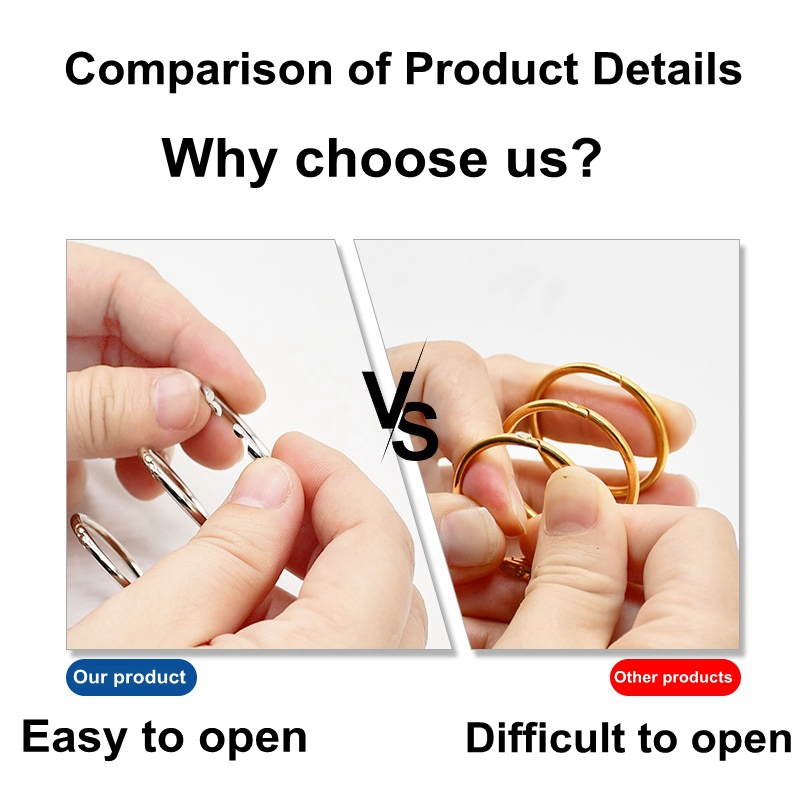
The opening and closing core of 3 ring binder rings relies on a high-precision built-in spring. High-quality springs have stable elasticity, which can realize one-hand easy opening and tight automatic closing. There will be no loose bouncing, jamming, or insufficient closing force after long-term use. The aligned ring interface ensures no gaps after closing, preventing paper from slipping out or being damaged.
4. Standard Sizes and Capacity Specifications
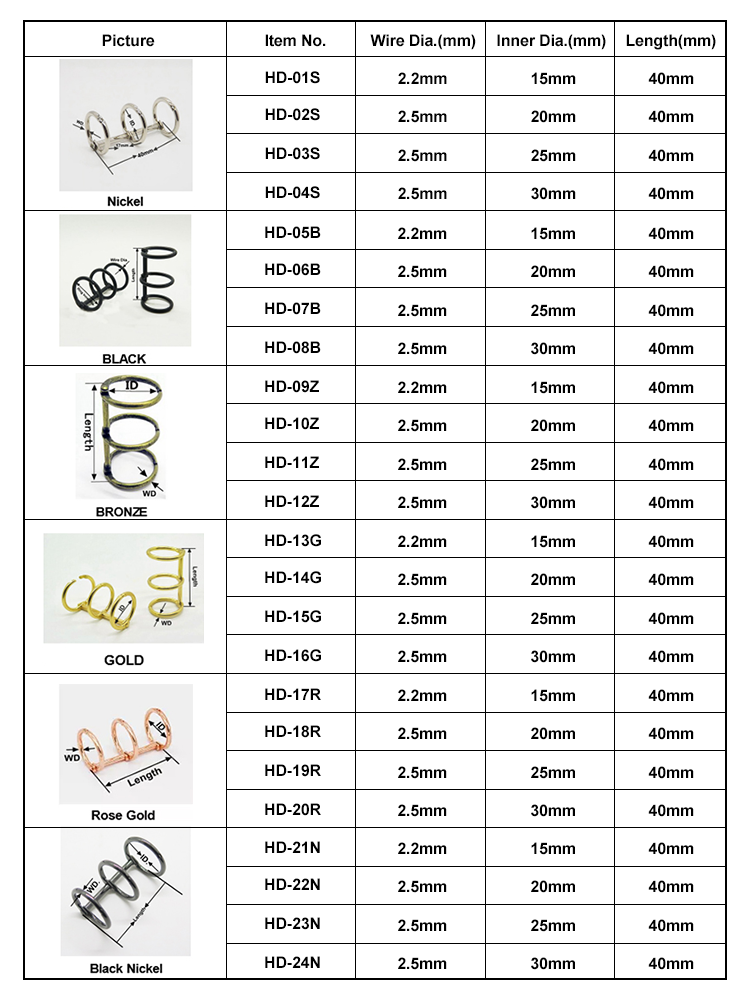
3 ring binder rings have unified international standard sizes, measured by ring inner diameter. Different sizes correspond to different paper storage capacities, meeting the organizational needs of thin notes and thick file materials.
1/2 Inch (12.7mm): Mini size, suitable for thin loose-leaf notes, pocket planners, and small card sorting, holding about 50 to 80 sheets of standard 20lb copy paper.
1 Inch (25.4mm): The most versatile daily size, suitable for student daily notebooks, conventional office files, holding about 150 to 200 sheets of paper, balancing portability and capacity perfectly.
1.5 Inch (38.1mm): Medium capacity size, ideal for course summary materials, project files, and monthly work records, holding about 250 to 300 sheets of paper.
2 Inch (50.8mm): Large capacity size, suitable for thick professional documents, semester teaching materials, and long-term archived files, holding about 400 to 500 sheets of paper.
It is worth noting that the actual capacity is affected by paper thickness. Thick coated paper and kraft paper will reduce the number of storable sheets appropriately, while ultra-thin copy paper can increase the capacity moderately. D-ring products have a larger effective storage space than O-rings of the same size.
5. Wide Application Scenarios of 3 Ring Binder Rings
The flexibility and practicability of loose leaf binder rings make them widely used in home, school, office, and creative DIY fields, becoming an indispensable organizational tool for all groups.
5.1 School Education Scenarios
For students of all ages, 3 ring binder rings are essential for daily study. Students can sort subject notes, exercise papers, test sheets, and knowledge points by subject and semester, replace and supplement content at any time, and avoid page waste caused by traditional fixed notebooks. Teachers can also use loose leaf binder rings to organize teaching courseware, classroom handouts, and student homework samples, facilitating repeated use and classified management of teaching materials.
5.2 Office Business Scenarios
In enterprise office environments, standardized 3 ring binder rings help employees sort contract documents, project reports, financial statements, and meeting minutes. Classified loose-leaf binding improves file retrieval efficiency, realizes dynamic update of document content, and is convenient for enterprise file archiving and regular sorting. Standard three-ring binding is also in line with international office document management specifications, suitable for business cooperation and document docking.
5.3 Personal DIY & Life Organization
Loose leaf binder rings are popular among DIY enthusiasts. Users can make personalized hand accounts, travel journals, photo albums, and budget planners by matching blank loose-leaf paper, decorative stickers, and custom covers. In daily life, they can also be used to sort recipe cards, reading notes, fitness records, and family account books, realizing flexible personalized management of life data.
6. How to Choose High-Quality Loose Leaf Binder Rings? (Buying Guide)
Faced with various 3 ring binder ring products on the market, users need to focus on the following core indicators to avoid inferior products with easy rust, easy deformation, and loose closure, and select cost-effective and durable products.
6.1 Check Material & Surface Workmanship
Prioritize nickel-plated steel or stainless steel binder rings. The surface should be smooth and uniform without burrs, peeling plating, or rust spots. Inferior products are mostly made of thin iron sheets with rough surfaces, which are easy to scratch paper and hands, and will oxidize and rust after a short period of use.
6.2 Test Opening and Closing Toughness
High-quality 3 ring binder rings have moderate spring elasticity, easy to open with one hand, and can be tightly closed automatically without manual extrusion. After repeated opening and closing, the rings are not deformed, and the interface is tightly fitted without gaps. If the ring is too tight to open laboriously, or too loose to close tightly and easy to bounce, it is an unqualified product.
6.3 Select Appropriate Shape and Size
Daily light use such as student notes and simple file sorting can choose cost-effective O-ring products; for thick documents, high-frequency flipping, and long-term archiving, it is recommended to choose high-capacity D-ring binder rings. Select the inner diameter size according to the actual paper thickness to avoid insufficient capacity or bulky redundant space.
Conclusion
As a classic and efficient document binding hardware, loose leaf binder rings and standard 3 ring binder rings have always been the core choice for global school, office, and personal organizational scenarios due to their flexibility, durability, and versatility. Understanding their material characteristics, shape differences, size specifications, and usage skills can help every user give full play to their organizational value and realize efficient sorting and long-term preservation of various documents.
Whether you need mini-size rings for portable notebooks, standard-size rings for daily office files, or large-capacity D-rings for thick professional materials, high-quality 3 ring binder rings can perfectly meet your needs. Choose professional loose leaf binder rings to upgrade your document management system and make study, work, and life sorting more standardized and efficient.