The Ultimate Guide to Loose Leaf Binder Rings: Versatility, History, and Buying Guide
The Ultimate Guide to Loose Leaf Binder Rings: Versatility, History, and Buying Guide
In the digital age, the tactile pleasure of paper endures. From DIY scrapbookers preserving memories to professionals organizing project specs, the need for flexible, reusable binding is universal. At the heart of this organizational revolution is a humble yet powerful tool: the **Loose Leaf Binder Ring**.
Often overlooked, these small metal or plastic circles are the unsung heroes of customization. Unlike permanent binding methods, loose leaf rings offer the freedom to rearrange, replace, or redesign your pages whenever inspiration strikes.
In this comprehensive guide, we will explore everything you need to know about book binding rings, from their historical origins to how to choose the right size for your next masterpiece.
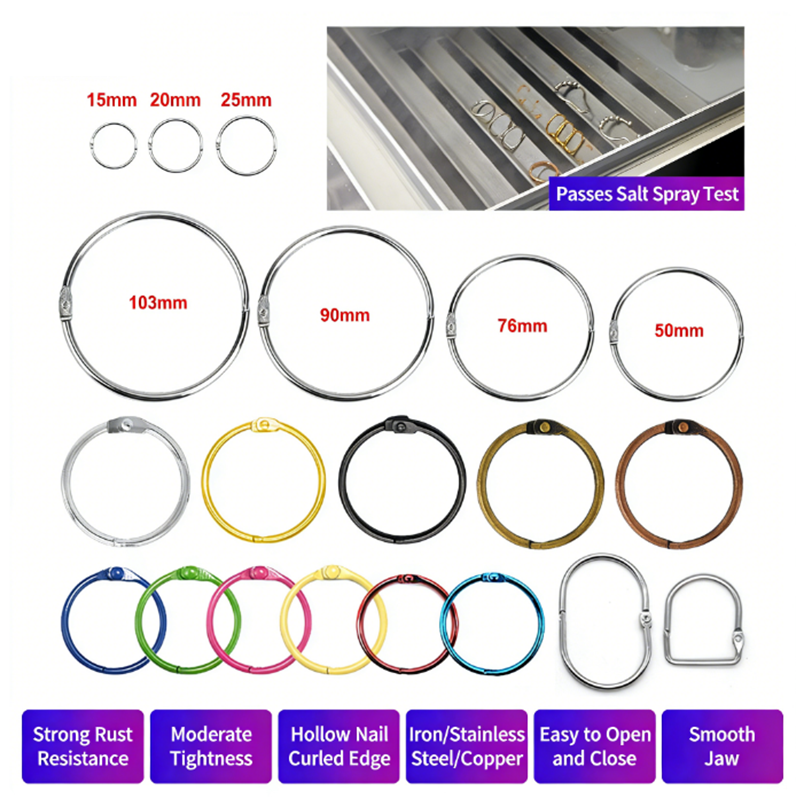
## What is a Loose Leaf Binder Ring?
A loose leaf binder ring (often called a book binding ring or scrapbook ring) is a circular or D-shaped fastening device used to bind hole-punched paper. Unlike a standard 3-ring binder mechanism sewn into a cover, these are individual rings that you thread through the paper manually .
They are designed for **simplicity and reuse**. Most high-quality rings feature a "snap-open" or "split-ring" design. With a simple twist of the fingers, the ring opens, you slide your pages onto the spine, and you snap it shut .
### Common Names & Terminology
If you are shopping for these parts, they go by many names. Knowing these terms will help you navigate our site and others:
- **Loose Leaf Rings**
- **Book Binding Rings**
- **Scrapbook Rings**
- **Binder Rings**
- **O-Rings or D-Rings** (referring to shape)
- **Post Binder Rings**
---
## A Brief History of Loose Leaf Binding
The concept of "loose" paper binding is surprisingly old. Before the modern ring, ledgers and account books used "post binding" – long screws that held pages together but were tedious to adjust .
The modern ring binder, however, traces its roots to 1886. German inventor **Friedrich Soennecken** registered a patent for a ring binder in Bonn, Germany. Shortly after, Louis Leitz (yes, *that* Leitz) refined the design, creating the standard we recognize today .
By the late 19th century, the loose-leaf mechanical binding structure was adapted from the developing loose-leaf binding industry. Patents for these mechanisms exploded in the 1890s, specifically for account books and order forms, because they allowed pages to be easily added or removed without destroying the binding . This flexibility made it the forerunner to the photo albums and scrapbooks of the 20th century.
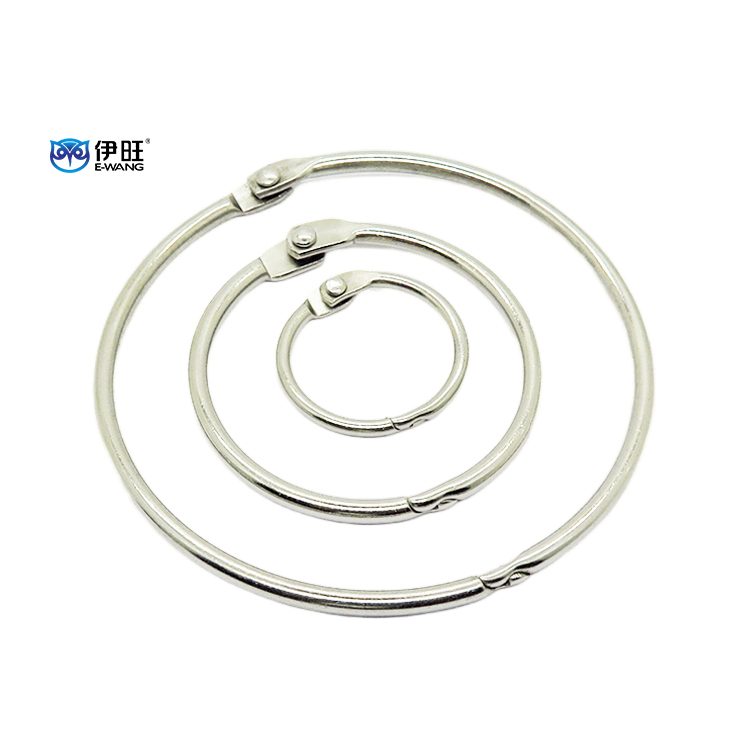
## Types of Loose Leaf Binding Rings
Not all rings are created equal. Choosing the right type depends on your project’s durability needs and aesthetic.
### 1. Metal Loose Leaf Rings (The Standard)
- **Material:** Usually stainless steel or zinc alloy.
- **Best For:** Professional notebooks, long-term archives, keychains, and heavy-use items.
- **Pros:** Extremely durable, rust-proof (if high quality), offers a "premium" feel, and snaps securely .
- **Cons:** Can be slightly heavier than plastic; sharp edges if poorly manufactured.
### 2. Plastic Binding Rings
- **Material:** Non-toxic PVC or durable polymers.
- **Best For:** Children's books, calendars, seasonal crafts, and shipping (lightweight).
- **Pros:** Available in a rainbow of bright colors, no risk of rust, cheap, and flexible. They are also "no smell" and non-toxic, making them safe for kids' projects .
- **Cons:** Can deform under heavy weight; may become brittle in extreme cold over years.
### 3. The "D" Shape vs. Round
- **Round Rings:** The classic circle. Good for turning pages 360 degrees. Best for small booklets or presentation folders.
- **D-Rings:** The straight edge of the "D" attaches to the spine, allowing the paper to stack flat and flush. **Pro-Tip:** If you are making a thick professional presentation, D-Rings look much cleaner on a shelf than round rings.
---
## Key Buying Criteria: Sizes and Capacities
When purchasing binding rings for your independent store or project, you need to match the ring size to the paper weight.
### Diameter & Sheet Capacity
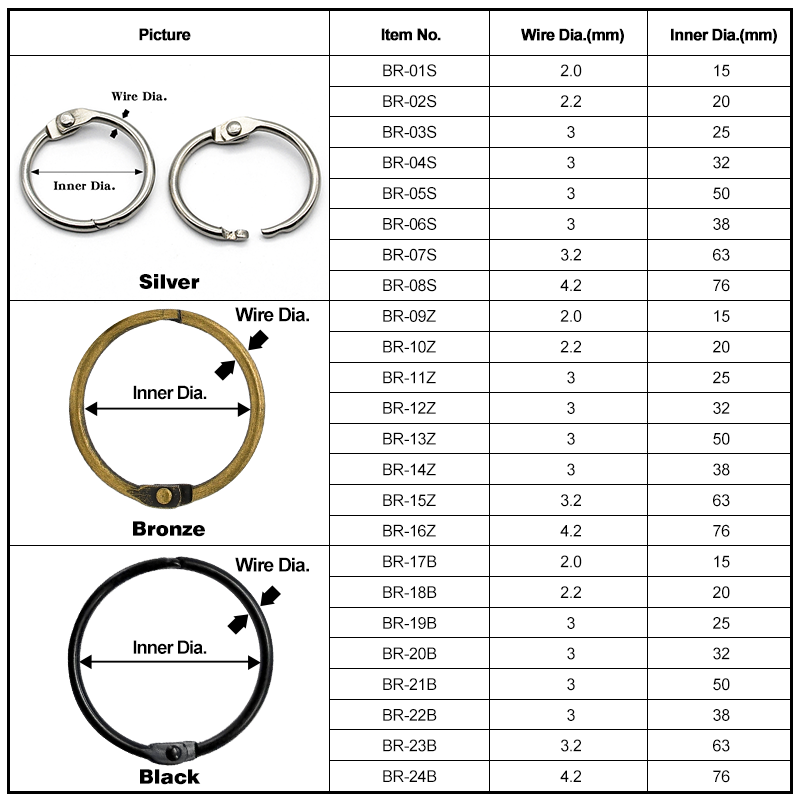
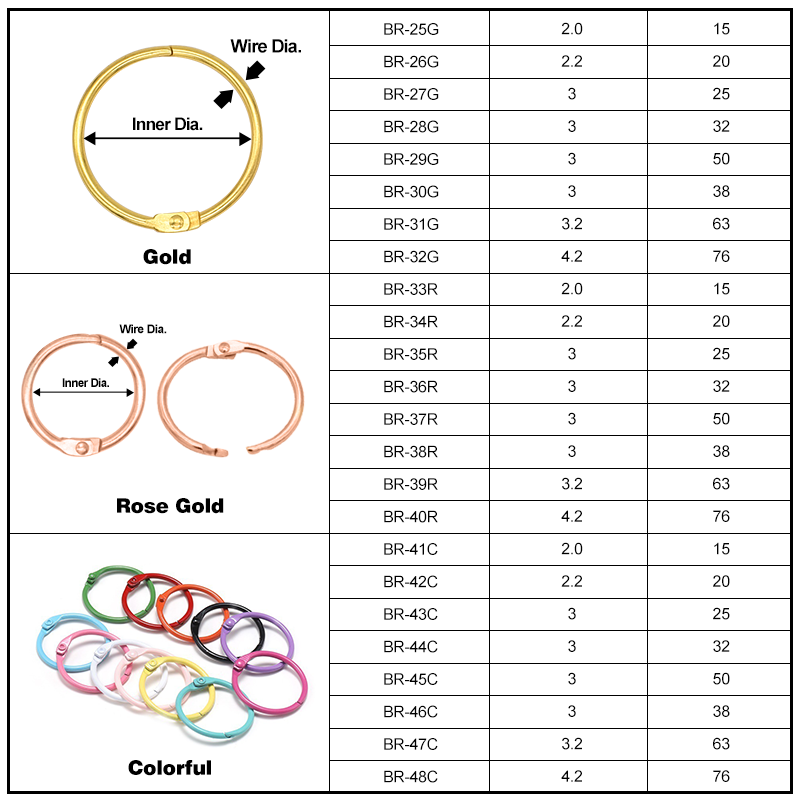
The inner diameter determines how much paper the ring can hold. Here is a rough guide based on standard 80gsm printer paper:
- **10mm – 13mm (0.5 inch):** Holds approx. 75–100 sheets. Best for thin reports, pocket notebooks, or cookbook index cards.
- **16mm (0.75 inch):** Holds approx. 135 sheets. Good for thicker photo albums or quarterly reports .
- **22mm – 25mm (1 inch):** Holds approx. 180–200 sheets. The "sweet spot" for scrapbooking and diary keeping .
- **32mm – 50mm+ (1.5 - 2 inches):** For giant ledgers or security logs.
*Note: Always check the "Pitch" (the distance between holes on your paper). American standard is 3-hole (4.25" spacing), while many international DIY books use 30-hole (Japanese binding) or 3:1 pitch plastic rings .*
## DIY Projects Using Loose Leaf Rings
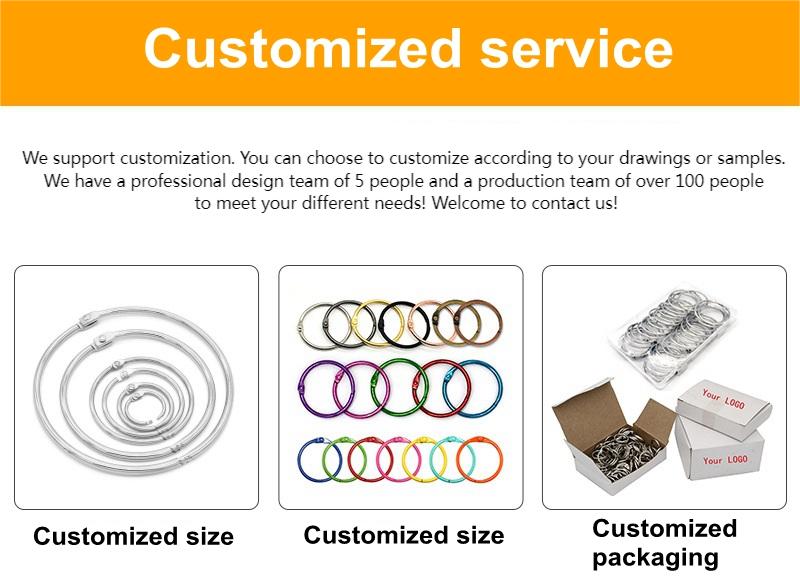
Our independent store stocks these rings because they empower **creativity**. Here are the top 5 ways customers use them:
### 1. The Scrapbook & Photo Album
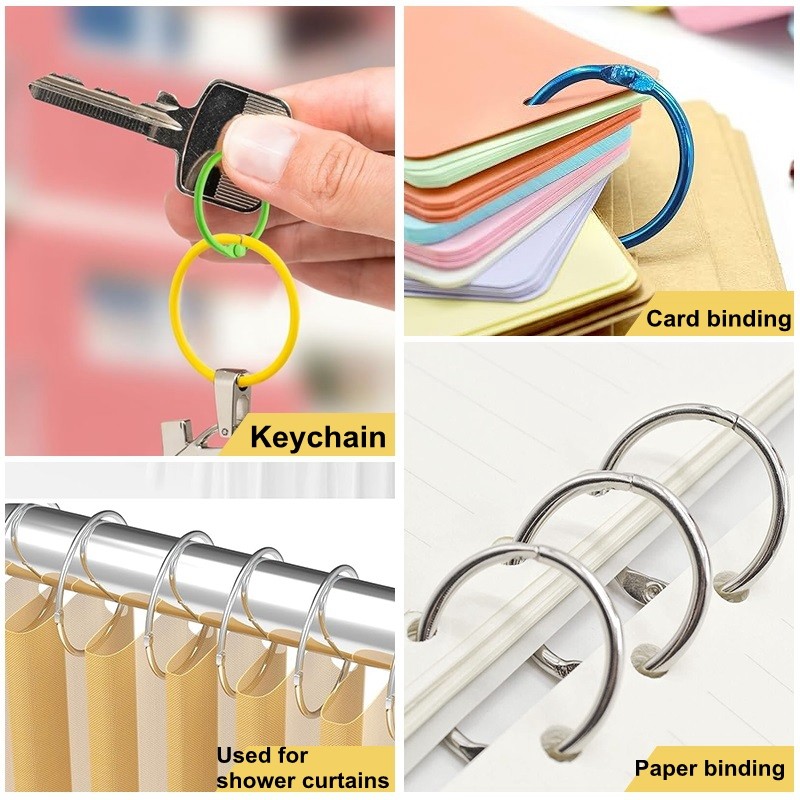
The most popular use. Because you can open and close the rings up to 10,000 times, you can rearrange your scrapbook pages forever. You can add a graduation photo today and a holiday card next month without ripping anything out .
### 2. Traveler’s Notebooks
The "Traveller’s Notebook" trend is huge. Users buy a leather cover and use elastic bands or *loose leaf rings* to hold multiple inserts (dot grid, blank, planner) in one cover.
### 3. Resin Art & Mixed Media
Artists love **3-layer book binding rings** . They use them to bind samples of their work, swatch books for resin colors, or create heavy-duty sample boards for craft fairs.
### 4. Presenter's Flip Books
For corporate clients, a large loose leaf ring is a fantastic alternative to a spiral coil. It allows a salesperson to remove an outdated page and insert a new price sheet seconds before a meeting.
### 5. Keychains & Accessories
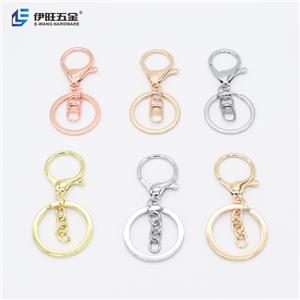
Small 20mm rings are perfect for holding "Ranger Eyelets" or "Tiny Tabs." They can be used as keychains, badge holders, or connecting links for bag charms .
---
## Why Choose Loose Leaf Over Spiral or Wire Binding?
If you are on the fence about which binding method to use for your small business product, consider this comparison:
| Feature | Loose Leaf Rings | Spiral / Wire-O |
| :--- | :--- | :--- |
| **Reusability** | High (Rings snap open/closed) | None (Once bent, it's permanent) |
| **Page Removal** | Easy (Lift the latch) | Difficult (Requires cutting or uncoiling) |
| **Aesthetic** | Rustic, Industrial, "Boutique" | Standard, Corporate |
| **Customization**| Mix colors/types in one book | Single color/type only |
| **Lay Flat** | Yes (Especially D-Rings) | Yes |
For products that are **evergreen** (like planners, recipe books, or portfolios), loose leaf rings are superior because the product doesn't expire when the pages do—the user just buys refills.
## Maintaining Your Binder Rings
To ensure your binding hardware lasts for years:
1. **Don't Overstuff:** If you have to force the ring closed, it will eventually bend out of shape or snap.
2. **Check for Rust:** If using metal rings in a humid environment (kitchen or bathroom art), ensure they are stainless steel or coated .
3. **Avoid Heat:** Keep plastic rings away from heaters or cars in summer, as they may warp .
## Conclusion
The loose leaf binder ring is more than just office stationery; it is a tool for **renewal**. Whether you are a small business producing limited-run planners, or a parent preserving a child's artwork, these rings provide the flexibility that glued or stitched books cannot.